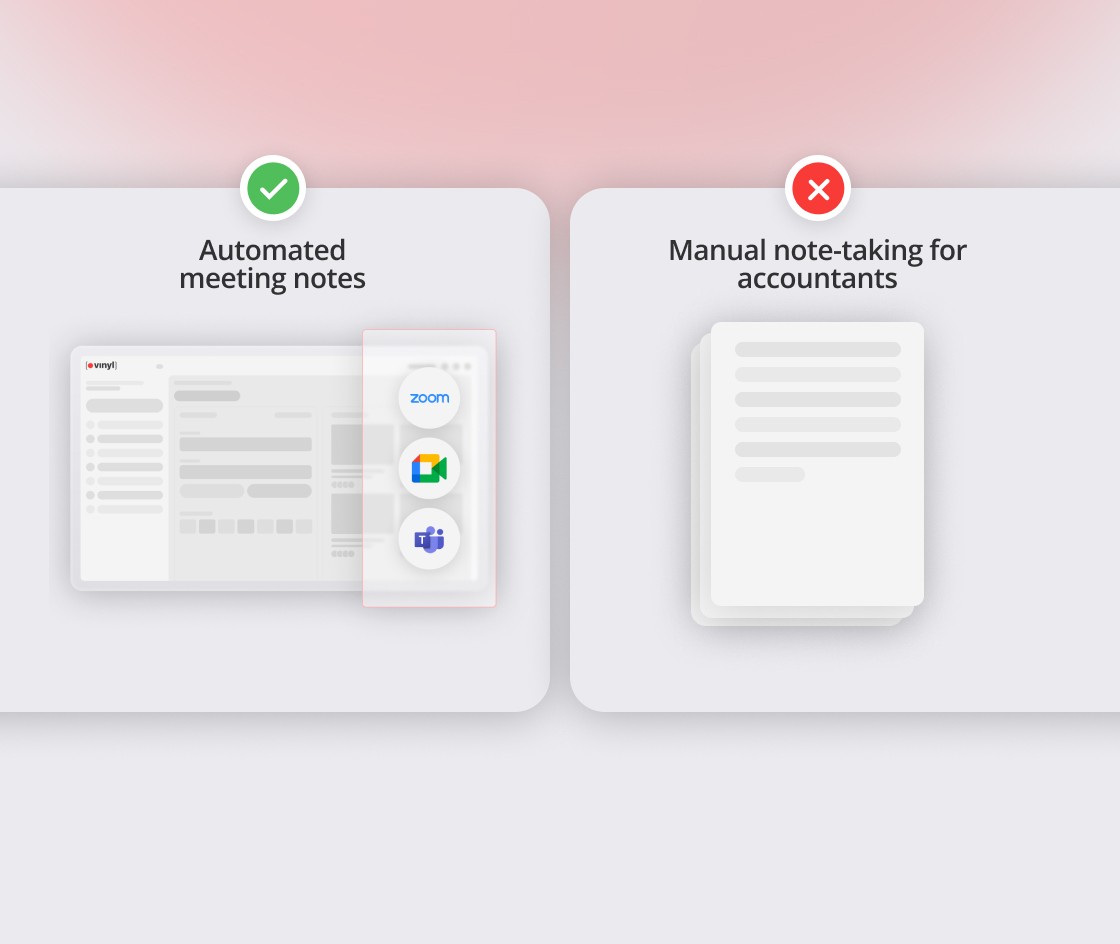
AI meeting notes automation is revolutionising how accounting professionals document client interactions, allowing them to stay fully present while capturing comprehensive records.
Manual note-taking forces accountants to choose between active listening and documentation, often resulting in missed details and illegible notes that waste 3-6 hours weekly to decipher.
AI tools can achieve up to 95% transcription accuracy and automatically generate action items, eliminating post-meeting administrative burden while creating searchable audit trails for compliance.
Automated meeting notes integrate seamlessly with video platforms like Zoom, Google Meet and Teams, syncing directly with practice management systems to streamline client relationship management.
The shift from manual to automated note-taking represents a fundamental improvement in client service delivery, enabling accountants to focus entirely on providing valuable financial guidance while maintaining comprehensive documentation standards.
AI-powered meeting notes automation is transforming how accounting professionals document client interactions. In fact, 32% of surveyed accounting firms are already using AI to transcribe calls and meeting notes, with transcribing meetings to generate minutes and action items cited as one of the top AI use cases in the profession’s state-of-the-nation research, alongside drafting emails and researching tax rules. Accountants know the challenge of staying focused during important client meetings while taking notes that become hard to decode later.
These AI meeting notes automation tools can improve efficiency by a lot. They automatically handle much of the follow-up work from each meeting when implemented correctly. The tools provide automated summaries and meeting expressions that save valuable time. Accountants no longer need to rely on incomplete handwritten notes or recall important details after meetings. A combination of speech recognition, natural language processing, and machine learning captures every word and lets professionals stay fully present during conversations.
This piece explores how these technologies revolutionise accountants' work, the challenges they solve, and the best ways to implement them in your firm.
Manual note-taking: Challenges for accountants
Manual note-taking creates several problems that affect productivity and accuracy. That’s why accountants need to know how to document client meetings properly to maintain compliance and serve clients better.
Upon surveying 259 accounting firms about post-meeting admin, our research shows just how costly weak documentation processes have become. The median accountant loses 3.8 hours per week to post-meeting admin, and 57% spend 30 minutes or more on follow-up work after every single meeting.
Hard to stay present and take notes
Taking notes by hand puts us in a tough spot: we must choose between writing things down or staying active in the conversation. This mental juggling makes it hard to stay focused during client meetings. We spend too much time deciding what deserves a note versus what we should remember, which stops us from fully joining discussions. The process of writing becomes distracting – we worry about writing faster instead of listening to what clients say.
This tension shows up clearly in the data. Vinyl’s research found that 60% of accountants struggle most with capturing notes and action items accurately. The problem is not effort – it is divided attention.
Risk of missing key details
Even the most careful note-takers miss vital information sometimes. One accountant learned this the hard way: she rushed through an important client call, made quick bullet points but missed a vital objection. This mistake hurt her credibility, and she ended up losing the sale. Our field demands precision, and these oversights can damage both compliance work and client relationships.
When follow-up responsibilities are unclear, the cost compounds. Vinyl’s research also highlights that fragmented systems and unclear action ownership are recurring friction points across firms.
Issues with handwriting and shorthand
People write about 15 words per minute by hand. This means when clients share multiple ideas faster, we must make tough choices:
Skip information we think we'll remember (but usually forget)
Write messily, leaving us with unreadable notes
Miss context because we focus on keeping up
Most accountants don't know they waste 3-6 hours each week trying to decode their own handwritten notes.
Time lost in post-meeting brain dumps
Note-taking doesn't stop when meetings end. We must spend extra time turning scattered notes into clear action items. Without setting clear “next actions” and responsibility before meetings finish, people often neglect or forget important tasks.
This is where the data becomes especially clear. Firms attending higher meeting volumes see compounding admin. Professionals handling 11–20 meetings per week and spending over an hour on post-meeting admin can lose nearly 12 hours per week to follow-up alone.
This extra administrative work creates inefficiency, especially when multiple client relationships and projects are running at once.
Meeting notes automation tools address these structural issues by capturing discussions in real time, extracting action items, and organising them by client – allowing accountants to stay focused and engaged during the meeting itself rather than reconstructing it afterwards.
How AI meeting notes automation works
AI meeting notes automation uses advanced technology that frees accountants from documentation tasks. The tools work quietly to capture every detail when accountants talk to their clients.
Live transcription and summarization
Today's meeting notes automation tools turn conversations into text with impressive accuracy. Users see up to 95% accuracy in transcriptions, which means financial discussions are documented without errors. These systems go beyond simple transcription and use natural language processing to spot and extract key details such as decisions, action items, and valuable insights from meetings. The system creates short summaries that highlight the main points once the conversation ends, which makes review quick and easy.
Integration with Zoom, Teams, and Meet
The best meeting notes automation tools integrate directly with video conferencing platforms. They can join scheduled meetings on Zoom, Microsoft Teams and Google Meet as a visible participant, ensuring transparency and supporting client consent. For accounting firms, this visible-bot approach builds trust and avoids ambiguity around recording.
Vinyl is designed specifically for accounting and bookkeeping workflows, ensuring that captured meetings are automatically organised by client and contact rather than stored as isolated transcripts.
Automated task creation and CRM sync
The true value for accounting firms lies in how these tools extract action items from conversations. The AI spots commitments, deliverables, and deadlines mentioned in client meetings and turns them into trackable tasks. Team members get these tasks automatically based on what was discussed. These solutions also connect directly with practice management systems like Karbon, FYI and Xero Practice Manager, which puts meeting notes, client interactions, and follow-up tasks in one place. Accountants no longer need to spend time on manual data entry after client meetings.
Searchable transcripts and audit trails
Detailed, searchable records are a great way for accountants to create value. Meeting notes automation creates a clear record of all client conversations. These transcripts become a knowledge base where you can find specific discussions about tax strategies, compliance issues or financial decisions by searching keywords. This makes meeting transcripts more than just documents. They become dynamic tools that support evidence-based decisions and compliance documentation.
Benefits of automated meeting notes for accounting firms
AI-powered meeting notes automation brings significant advantages to accounting professionals. These tools streamline processes and enhance client service quality.
Improved accuracy and detail
AI meeting notes tools help accounting firms capture 95% more information than manual methods. AI captures every financial figure, tax strategy and client concern with precision, unlike handwritten notes. Accountants who try to listen and document simultaneously often make costly mistakes. AI notetakers also spot anomalies and outliers that humans might miss, which improves data integrity in client interactions.
Better compliance and documentation
Automated meeting notes create a central, secure hub for all client conversations as regulatory requirements become more complex. The system timestamps and stores every discussion to create an audit trail that protects firms and their clients. These detailed records are particularly valuable for accountant-client privilege matters and help prevent documentation gaps.
Faster follow-ups and task tracking
AI generates action item summaries right after meetings end and clearly defines responsibilities and deadlines. Teams can start work right away without spending time organizing post-meeting notes, and this can save about 50 minutes per accountant for each meeting through automated follow-ups.
No reliance on memory or manual entry
Accounting discussions often include complex numbers that are hard to remember accurately. AI notetakers remove this mental burden. Systems and documentation provide protection rather than memory. This approach prevents decisions from getting lost or misinterpreted after meetings end.
Transcripts reused for emails and reports
Meeting transcripts are great foundations for various client communications. Accountants can use parts of conversations in follow-up emails, updates or detailed reports without starting over. Client meetings become content resources that maintain consistency across all communications.
Risks and best practices for using AI notetakers
Meeting notes automation offers many benefits, but some risks need careful attention. Accountants can maximise benefits and minimise potential risks by following best practices.
Importance of reviewing AI-generated notes
AI-generated notes should not be considered final. Think of them as a draft from a junior team member that needs a full review. You should check every transcript before making it an official record, especially when it contains financial decisions or compliance matters.
To minimise any risk, it is essential to use tools that allow full control over AI-generated outputs. Vinyl enables users to review, edit and refine meeting summaries and discussion points before they are saved. This ensures the final documentation reflects professional judgement rather than raw automation, while maintaining accuracy and accountability.
Client consent and data privacy compliance
Let participants know before you start AI notetaking. States like California legally require everyone's consent for recordings. Getting clear permission builds trust with clients who might feel uneasy about automated documentation. Your organisation needs clear policies about how you store, access, and delete meeting data.
Choosing tools with strong data protection standards
When handling client conversations that may contain sensitive financial or strategic information, data protection must be a priority. If your firm works with EU clients, GDPR compliance is essential. You should also assess how meeting data is stored, accessed and managed within the platform.
Meeting transcripts often include confidential discussions about financial strategies and proprietary information, so selecting a provider with clear data handling practices (such as not using data from a client meeting to train AI) and transparent security policies is critical.
What firms say after implementing Vinyl
Across Vinyl’s published case studies, accounting firms consistently describe the same shift: meetings move from being loosely documented conversations to structured, trackable workflow inputs.
At Box Advisory, the team previously relied on inconsistent handwritten notes and delayed follow-ups. After implementing Vinyl, they reduced follow-up time from up to two weeks to just one or two days. The founder explained that Vinyl effectively replaced the need for an additional support person in meetings, freeing capacity while maintaining clarity and accountability.
Shapes, a fast-growing advisory firm holding 15–20 meetings per week, reported a noticeable change in meeting dynamics. By removing the distraction of manual note-taking, the team found they could listen more actively and ask better questions. Instead of juggling scattered notes, every meeting became consistently captured and structured.
Barry Accountants highlighted the cumulative time impact. With 30–50 meetings per week across the team, saving even 20 minutes per meeting translated into meaningful capacity gains without increasing headcount.
At High Rock Accounting, the decision to move away from generic transcription tools was driven by the need to centralise meeting records directly inside their workflow system, creating better visibility and stronger client follow-through as well as freed capacity on the team.
Together, these examples reinforce a consistent theme: structured meeting capture reduces admin friction and improves execution across the firm.
Conclusion
AI-powered meeting notes automation has changed how accountants document and process client interactions. Manual note-taking creates many challenges. Accountants can't stay fully present during meetings, risk missing key details, and waste time trying to figure out handwritten notes later.
Meeting notes tools powered by AI fix these issues through up-to-the-minute transcription, automated summaries, and continuous connection with video conferencing platforms. This allows accounting firms to record almost every detail of client conversations. Their professionals can now focus on meaningful client involvement.
All the same, these tools come with risks. Teams must carefully watch for transcription errors, wrong speaker attribution, and context understanding limits. On top of that, client consent and data privacy should stay as top priorities when using these technologies.
The benefits make adoption worth it, despite these challenges. Automated meeting notes create a complete audit trail with searchable records that make compliance and documentation easier. Quick generation of action items speeds up follow-up work and saves time that was lost to organising notes after meetings.
The most vital change is in client interactions. We can now give clients our complete attention instead of splitting focus between notes and listening. So accounting firms that accept new ideas in meeting notes automation can deliver better service while working more efficiently.
This change from manual to automated notes reflects our profession's bigger transformation. Accountants need to assess these tools carefully and put proper safeguards in place. We ended up accepting technologies that let us focus on what matters most – giving outstanding guidance to our clients.
FAQs
Are AI meeting note-taking tools legal for accountants to use?
AI note-taking tools are legal, but accountants should be cautious about privacy and confidentiality. Always obtain client consent before using such tools and choose providers that comply with data protection regulations.
What are the main benefits of using automated meeting notes for accounting firms?
Automated meeting notes improve accuracy, capture up to 95% more information than manual methods, create searchable audit trails for compliance, accelerate follow-ups through automated task creation, and allow accountants to focus entirely on client interactions.
How do AI meeting note tools integrate with existing accounting workflows?
These tools seamlessly integrate with video conferencing platforms like Zoom, Google Meet and Microsoft Teams. They can automatically join scheduled meetings, transcribe conversations in real-time, and sync with practice management systems to streamline client relationship management.
How can accountants ensure the security of client information when using AI note-taking tools?
To protect sensitive financial data, choose tools with data protection compliance. Establish clear policies for data storage, access and deletion. Always inform clients and obtain their consent before using AI note-taking tools in meetings.

Co-Founder

Table of Contents
Start using Vinyl today
Automatically capture all of your meeting notes
Sync notes & actions to your practice management system
Don't let actions & follow ups fall through the cracks
Start capturing meetings with Vinyl today
"I've been wary of AI notetakers in the past...but Vinyl just gets it. So easy to set up, and the summaries hone in on all the important items. Everything just happens automatically, reducing all the small tasks that quickly add up."