Advisory services often fail to scale not because of lack of demand, but because expertise stays locked in partners’ heads instead of being captured, structured, and shared across the firm.
Key points:
Why advisory delivery typically depends on a few experienced partners, creating bottlenecks
The challenge of “invisible playbooks” where knowledge exists in conversations, not documented processes
How lack of time prevents firms from formalising advisory methods and training materials
The importance of capturing real client meetings to preserve knowledge and context
How analysing past conversations helps build practical, repeatable advisory playbooks
The role of structured frameworks in standardising meeting flow, questions, and decision-making
If advisory in your firm still depends on “that one partner who’s brilliant in client meetings”, you’re not alone…
Most firms want to scale advisory. But in reality, it’s stuck in a loop:
the partner runs the best conversations
everyone else tries to copy it
the “process” lives in people’s heads
and every new hire starts from scratch (again)
Meanwhile, demand for advisory keeps climbing. In the latest CPA.com / AICPA PCPS Client Advisory Services (CAS) benchmark survey, firms projected a median 99% growth in CAS revenue over three years. That’s basically “we’d like to double this”. Great news… unless delivery is still bottlenecked by two humans and a heroic spreadsheet.
We’re Vinyl. We build an AI meeting assistant for accounting firms. And we’ve seen a practical way to standardise and scale advisory without turning your team into robots.
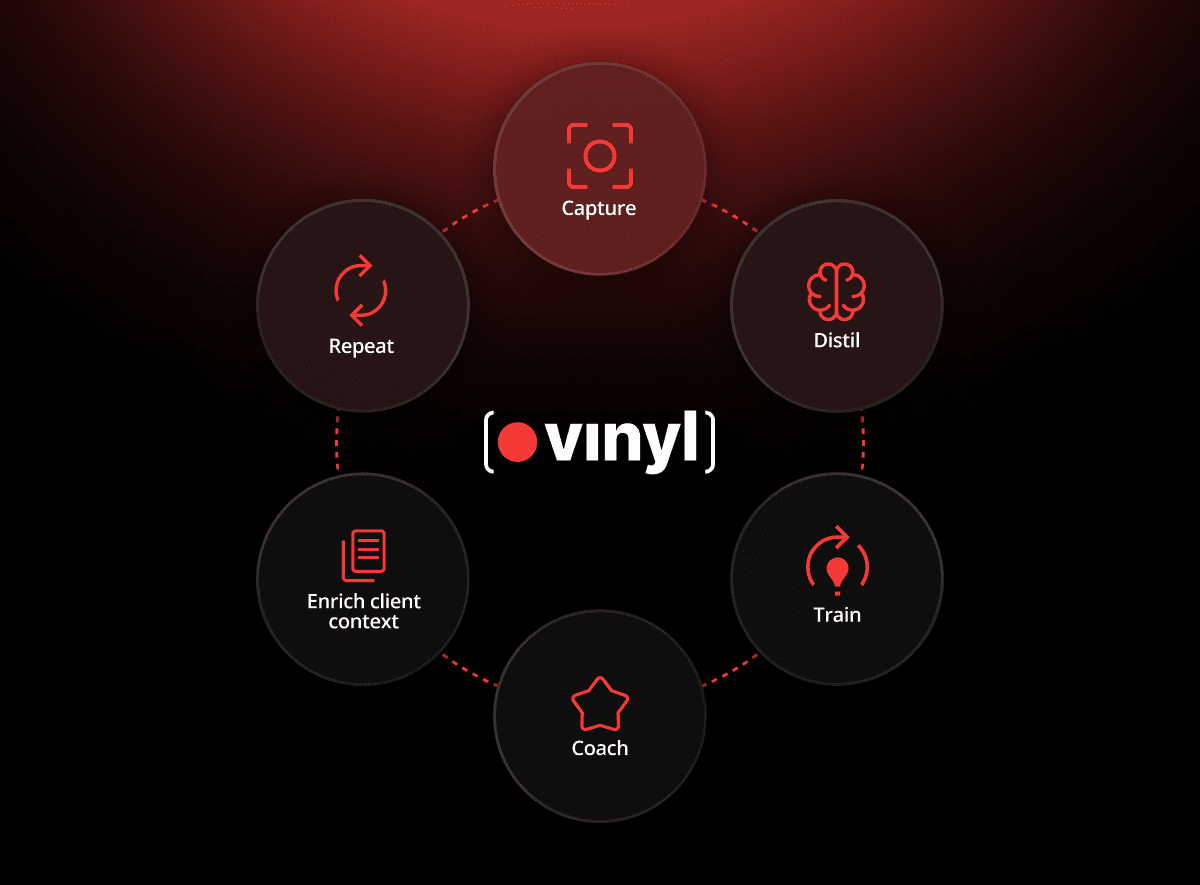
It’s a simple loop:
Capture → Distil → Train → Coach → Enrich client context → Repeat
Let’s unpack it.
Why advisory doesn’t scale in most firms
The “invisible playbook” problem
Partners are good at advisory because they’ve built judgement over years:
what questions to ask (and in what order)
how to steer a messy conversation back to outcomes
how to handle pushback without sounding like a sales script
how to turn numbers into decisions
But that knowledge is usually tacit. It’s not in a manual. It’s not in a checklist. It’s in the partner’s brain… and in the way they run meetings.
The “we’re too busy to document it” problem
Even if a partner wants to document their approach, it rarely happens. Not because they’re lazy, but because they’re slammed.
And meetings are already eating up the week. Not to mention the post-meeting admin tax: writing up meeting notes, adding them to practice management systems, sending follow-up emails, etc.
So “let’s document the advisory methodology” becomes one of those lovely ideas that lives in a Notion page titled Advisory Playbook v0.1 (WIP).
1) Capture partner expertise where it already exists: in real meetings
Advisory isn’t a PDF. It’s a conversation.
Quarterly business reviews (QBR's). Cashflow calls. Pricing discussions. Strategy sessions. The best firms already have the raw material for standardisation — it’s just trapped in meeting recordings (or worse, someone’s memory).
Vinyl’s first job is boring-in-a-good-way: we help you capture those advisory meetings without adding admin. That matters because bad meetings don’t just waste time — they create a hangover.
When you capture meetings properly, you get:
a searchable record of what was actually said
consistent notes and actions
and a trail of context that doesn’t vanish when someone’s on leave (or leaves the firm)
2) Distil partner know-how into a repeatable playbook
Here’s where things get interesting.
Instead of asking partners to “write down how you do advisory”, we can work backwards:
Select a set of strong examples (say, the last 10–20 QBRs run by your best advisory partner).
Analyse those transcripts together.
Extract the patterns.
That gives you an actual playbook built from real client work — not theory.
What a “playbook” can include (without becoming a novel)
From a batch of similar meetings, you can typically pull:
A meeting structure (opening, diagnostic, insight, decisions, actions)
A question bank (the prompts that reliably unlock useful answers)
Common client objections (and the responses that work)
Red flags (signals the conversation is drifting into “reporting mode”)
Next-step templates (how actions are framed, assigned, and followed up)
And because it’s based on actual transcripts, it captures the language that works — the phrases partners use to challenge assumptions without starting a war.
3) Turn the playbook into training juniors will actually use
Traditional training often looks like this:
“sit in on a few calls”
“read this doc”
“have a go”
“we’ll review later”
It’s not terrible. It’s just slow. And inconsistent.
Once you’ve captured meetings and extracted a framework, juniors can learn by asking grounded questions across many real examples — not just the one call they happened to shadow last Tuesday.
Examples of the kinds of questions juniors can ask
Here are a few we see a lot:
What they ask | What they’re really trying to learn | What they get |
|---|---|---|
“What’s Sam’s process for running a QBR?” | Structure and flow | A step-by-step meeting framework |
“How do we respond when a client pushes back on price?” | Handling tension | Patterns + example wording that worked |
“What challenges come up most in these meetings?” | Theme-spotting | A ranked list of recurring issues |
“What do we usually recommend in scenario X?” | Decision-making | Common recommendations + context |
The goal isn’t to turn juniors into copycats. It’s to shorten the “awkward middle phase” where they know the numbers but don’t yet know how to guide a commercial conversation.
And yes — it also helps partners stop repeating the same coaching points like they’re stuck in a Groundhog Day remake for accountants.
4) Coach and quality-check delivery without becoming the meeting police
Standardising advisory isn’t just documenting what “good” looks like. It’s helping the whole team deliver it consistently.
Once you’ve got a framework, you can review meetings against it and give feedback with evidence.
A simple scoring rubric (example)
For a Quaretly Business Review style meeting, you might score:
Preparation: did they bring the right context into the call?
Discovery: did they ask the key diagnostic questions?
Insight: did they interpret, not just report?
Direction: did the conversation land on decisions or priorities?
Next steps: are actions clear, owned, and time-bound?
With transcripts, coaching becomes less “I didn’t love the vibe of that meeting” and more “you skipped discovery, so the recommendation landed flat”.
It’s also kinder. Nobody enjoys mysterious feedback.
5) Build a client narrative that survives staff changes
Even strong firms lose context. People get promoted, move teams, go on parental leave, or leave. And suddenly the client relationship history becomes:
last year’s accounts
a task list
a few scattered emails
maybe a note saying “client worried about cashflow”
Meeting context is often the missing layer. It contains:
goals and priorities (“we’re trying to open a second site by September”)
constraints (“cash is tight until Christmas”)
decision rationale (“we’re holding off hiring because…”)
internal dynamics (“I need to convince my co-founder”)
When you add that to your existing tools (practice management timelines, workpapers, advisory apps), you get a much more complete profile — sometimes the most useful view of the client short of reading their bank feed and sitting in their office.
What changes when you do all four?
When you combine the four angles — playbooks, training, coaching, and client narrative — a few practical things happen:
Partners stop being the only “advisory engine” in the firm.
Juniors ramp faster because they can learn from patterns, not anecdotes.
Meeting quality becomes more consistent, even across different offices and managers.
Client context stops leaking out of the business every time someone changes role.
Advisory becomes a system, not a personality trait.
Also, and we say this with love: fewer people have to write “see last meeting notes” when there are no last meeting notes.
A quick reality check (because life happens)
None of this requires perfect data, perfect meetings, or a perfect firm.
It starts with what you already have: real advisory conversations, run by the people who are already good at them.
And it builds something firms rarely get time to build otherwise:
A repeatable way to deliver advisory that doesn’t depend on cloning your best partner (which, legally and ethically, is probably for the best).
Frequently Asked Questions
Why do so many accounting firms struggle to scale advisory services?
Because advisory delivery often depends on the experience and judgement of a small number of partners. When knowledge lives in people’s heads instead of shared processes, it becomes difficult for the wider team to deliver the same quality of conversations consistently.
What usually prevents advisory knowledge from being shared across the team?
The biggest barrier is time. Partners are busy running meetings, managing clients, and handling follow-up work, which leaves little room to document how advisory conversations are actually delivered. As a result, valuable insights remain informal and are shared inconsistently, if at all.
Why isn’t traditional training enough to develop strong advisory skills?
Traditional training often relies on shadowing a small number of meetings or reviewing internal documents, which can be slow and uneven. Without exposure to a wider range of real examples, junior team members struggle to recognise patterns, handle pushback confidently, or guide conversations toward clear decisions.
How can firms turn strong advisory conversations into a repeatable approach?
By working from real client meetings rather than theory alone. Reviewing successful conversations helps firms identify common structures, effective questions, and proven ways of framing recommendations. This creates a practical playbook based on what actually works in client interactions.
How does consistent meeting capture improve coaching and quality control?
When conversations are recorded and reviewed, feedback becomes more specific and objective. Managers can point to what worked well or what was missed, rather than relying on general impressions. This makes coaching clearer, fairer, and more actionable across the team.
Why is preserving client context so important as firms grow?
Client history can easily be lost when team members change roles or leave the firm. Meeting context captures goals, constraints, and decision rationale that don’t appear in financial statements alone. Preserving this context helps teams maintain continuity and deliver more relevant advisory over time.

Co-Founder

Table of Contents
Start using Vinyl today
Automatically capture all of your meeting notes
Sync notes & actions to your practice management system
Don't let actions & follow ups fall through the cracks
Start capturing meetings with Vinyl today
"I've been wary of AI notetakers in the past...but Vinyl just gets it. So easy to set up, and the summaries hone in on all the important items. Everything just happens automatically, reducing all the small tasks that quickly add up."